Nervelin Official Website › Blog › Garcinia And The Liver
Garcinia Cambogia And The Liver: Reading The Record Fairly
One of the nine names on this panel has a published liver-injury record behind it, including cases that reached acute failure and one that reached transplantation. That deserves a full article rather than a footnote, and it deserves to be read carefully rather than loudly.
- Garcinia cambogia is fourth on this panel, printed as Garcinia Cambogia Powder.
- A published case series describes moderate to severe liver injury; separate reports reach acute failure and transplantation.
- The NIH maintains a standing entry on it, which is not something every botanical has.
- The largest randomised trial of it, at 1,500 mg a day of hydroxycitric acid, found no difference from placebo on fat mass.
- The amount in this capsule is unknown, being part of a blend total, and is smaller than the doses in those reports. Both halves of that sentence matter.
What the ingredient is
Garcinia cambogia is the Malabar tamarind, a small tropical fruit whose rind contains hydroxycitric acid. The acid is the reason it is in supplements: it interferes with an enzyme involved in converting carbohydrate to fat, which is the mechanism every weight product carrying it is built on.
It reached the supplement aisle through weight management rather than through anything to do with nerves, and its presence on a nerve label is one of several signs that this blend was assembled from a general-purpose ingredient list.
Why it is on a nerve label at all
This is worth a paragraph before the safety record, because it frames everything that follows. Garcinia cambogia has no research in peripheral neuropathy. It has no proposed mechanism in nerve tissue. Its entire literature sits in body weight and appetite.
So its presence here is not a claim the label is making. It is a sign of how this kind of blend is assembled: from a general-purpose list of recognisable botanical names rather than from the evidence base for the condition on the front of the bottle.
Several of the other eight are in the same position. Raspberry ketones and apple cider vinegar both arrived in supplements through weight management; wild yam arrived through menopausal symptoms. Each of them is studied in something, and none of them is studied in this.
The practical consequence for a reader is simple. An ingredient with no research in your condition still brings its own safety record with it, and that record is the reason this one needs a full article rather than a line in a list.
The published injury record
The record here is unusually well documented for a botanical, and it did not come from campaigners. It came from clinicians publishing what they saw.
| The report | What it describes | What it establishes |
|---|---|---|
| A published case series | Moderate to severe liver injury across multiple cases | A pattern rather than a one-off, collected systematically |
| A single case report | Acute liver failure | The severe end of the same pattern |
| A second case report | Injury that proceeded to transplantation | The most serious outcome in the literature on this ingredient |
| A 2019 report | The same pattern, more recently | That the reports did not stop after the earlier ones |
| The NIH LiverTox database | A standing entry maintained on the ingredient | That a national reference body keeps it under review |
Five entries, none of them from a seller and none of them from a critic. This is the published record as it stands.
The NIH centre for complementary and integrative health also keeps a standing page on the ingredient. A national body maintaining a page is worth noticing on its own: most botanicals do not have one, and the ones that do have it for a reason.
The case series is the most informative single entry. One case report is a story; a series collected through a network designed to catch drug-induced liver injury is a pattern with denominators and methods behind it.
How to read case reports without panicking
Case reports are the beginning of an evidence trail rather than the end of one, and reading them well means holding two things at once.
They are genuine. Somebody was injured, a clinician investigated, and the report was published because the association looked real enough to write up.
They are also not a rate. A case series does not tell you how many people took the ingredient without incident, and without that denominator no probability can be calculated from it.
Four questions worth asking of any case report you meet:
- Was the ingredient taken alone, or in a product with several others?
- Was there a rechallenge, where symptoms returned on restarting?
- Were other causes of liver injury excluded, including alcohol and medicines?
- Did the reporting network collect cases systematically, or did they arrive by chance?
The published series scores well on the last of those, which is why it carries more weight here than any individual report. The individual reports matter for a different reason: they establish how severe the worst outcome has been.
This is an ingredient with a real signal and no established rate. That combination calls for naming it clearly to the people most at risk, and for not implying that everyone who swallows it is in danger.
What the efficacy trials found
The other half of a fair assessment is what the ingredient does when it works as intended, and here the record is thinner than its reputation.
| The trial | What it gave | What it found |
|---|---|---|
| The best-known randomised trial | 1,500 mg a day of hydroxycitric acid for twelve weeks in 135 people | No difference from placebo in fat mass |
| A trial in obese women | An extract over several weeks | A lipid effect, in a smaller and narrower population |
| An appetite study | A dose measured against appetite directly | The mechanism the ingredient is usually sold on |
Three trials, and the largest of them is the one that found nothing. The doses are grams a day of the active acid.
The largest of those trials gave 1,500 mg a day of hydroxycitric acid to 135 people for twelve weeks and found no difference from placebo in fat mass. It is the study most often left out of marketing copy, and it is the one with the most participants.
Putting the two halves together gives the honest position: a documented injury signal, and an efficacy record whose largest trial was null. That is a poor trade on its own terms, whatever the amount.
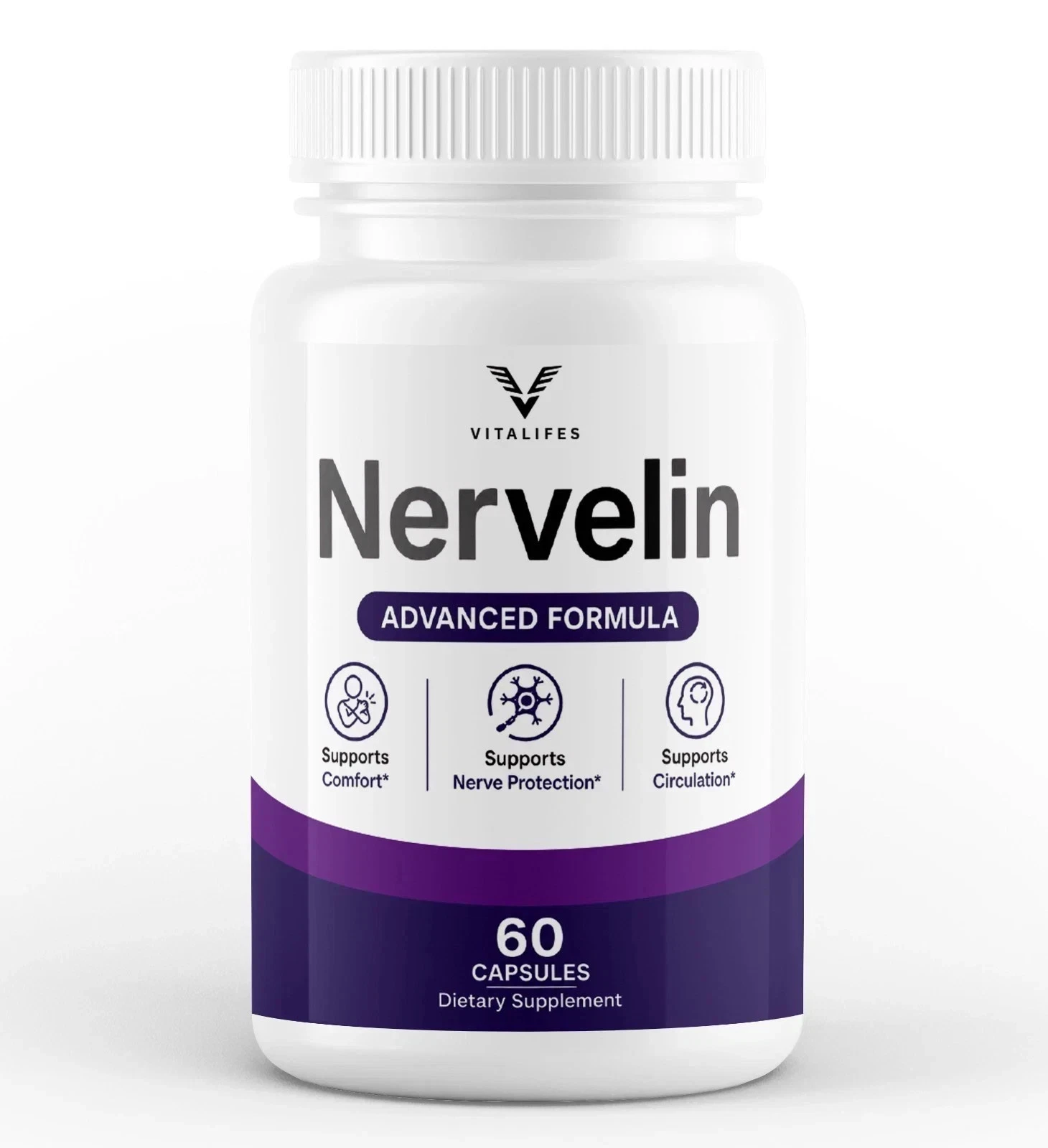
Nervelin: every ingredient read the same way
Nine names, each set beside what its own research found and what its own safety record holds, including this one.
Two capsules a day · 60 capsules a bottle · price at the marketplace checkout
Order Nervelin On The Official WebsiteLot NER-26/GE-1959 · marketplace return window · gelatin capsule
What this particular label means for the question
Here the blend total cuts in an unexpected direction. The panel declares 1000mg for 9 ingredients together, so the Garcinia share is necessarily a fraction of a gram — smaller, probably much smaller, than the 1,500 mg a day the trials used and than the amounts in the injury reports.
That is a genuine mitigation and it should be said before anything else. It is also incomplete, because the same blend total means nobody outside the manufacturer knows what the share actually is.
So the accurate sentence is the one with both halves in it: the amount is smaller than the doses in the literature, and it is unknown. A reader who takes only the first half away has been reassured further than the label supports.
A caveat repeated in every section is noise, and the owner of this desk was right to reject that. Stated once, at length, in the place where it is the subject, it is information.
Who should take this seriously
Most people reading this can note it and move on. A smaller group should not.
- Anyone with existing liver disease of any kind.
- Anyone taking a medicine with known liver effects, which is a longer list than most people expect.
- Anyone who drinks heavily, which changes the baseline this question is asked against.
- Anyone who has previously had an unexplained rise in liver enzymes.
For that group the useful action is specific rather than vague: name this ingredient to whoever manages your care, before starting, rather than mentioning supplements in general. Ingredient names are actionable; the word “supplements” is not.
It is also worth knowing what the warning signs of liver trouble look like, because they are unspecific early on: unusual tiredness, nausea, pain under the right ribs, dark urine, or yellowing of the eyes or skin.
What this article is not saying
It is not saying this capsule will injure you. There is no trial of this formula, no reported case involving this product, and the amount involved is a fraction of the doses in the literature.
It is not saying the ingredient should be banned, or that everyone selling it is reckless. That is a regulatory argument and this is a retail desk reporting a published record.
What it is saying is narrower and firmer: one of the nine names on this panel has a documented injury signal, a national reference body keeps a page on it, and a buyer is entitled to know that from the site selling it rather than from somewhere else three weeks later.
- A published case series, two severe individual reports and a 2019 report in the same pattern.
- A standing NIH entry, which is not routine for a botanical.
- The largest efficacy trial, at 1,500 mg a day, found no difference from placebo.
- The amount here is smaller than any of those doses, and unknown, and both facts belong in the same sentence.
References
- Heymsfield SB, Allison DB, Vasselli JR, et al. Garcinia cambogia (hydroxycitric acid) as a potential antiobesity agent: a randomized controlled trial. JAMA. 1998;280(18):1596-600. PMID 9820262. https://pubmed.ncbi.nlm.nih.gov/9820262/
- Vasques CA, Schneider R, Klein-Junior LC, et al. Hypolipemic effect of Garcinia cambogia in obese women. Phytother Res. 2014;28(6):887-91. PMID 24133059. https://pubmed.ncbi.nlm.nih.gov/24133059/
- Mattes RD, Bormann L. Effects of (-)-hydroxycitric acid on appetitive variables. Physiol Behav. 2000;71(1-2):87-94. PMID 11134690. https://pubmed.ncbi.nlm.nih.gov/11134690/
- Vuppalanchi R, Bonkovsky HL, Ahmad J, et al. Garcinia cambogia, Either Alone or in Combination With Green Tea, Causes Moderate to Severe Liver Injury. Clin Gastroenterol Hepatol. 2022;20(6):e1416-e1425. PMID 34400337. https://pubmed.ncbi.nlm.nih.gov/34400337/
- Corey R, Werner KT, Singer A, et al. Acute liver failure associated with Garcinia cambogia use. Ann Hepatol. 2016;15(1):123-6. PMID 26626648. https://pubmed.ncbi.nlm.nih.gov/26626648/
- Lunsford KE, Bodzin AS, Reino DC, et al. Dangerous dietary supplements: Garcinia cambogia-associated hepatic failure requiring transplantation. World J Gastroenterol. 2016;22(45):10071-10076. PMID 28018115. https://pubmed.ncbi.nlm.nih.gov/28018115/
- Yousaf MN, Chaudhary FS, Hodanazari SM, et al. Hepatotoxicity associated with Garcinia cambogia: A case report. World J Hepatol. 2019;11(11):735-742. PMID 31772720. https://pubmed.ncbi.nlm.nih.gov/31772720/
- Garcinia Cambogia. In: LiverTox: Clinical and Research Information on Drug-Induced Liver Injury. Bethesda (MD): National Institute of Diabetes and Digestive and Kidney Diseases. https://www.ncbi.nlm.nih.gov/books/NBK548087/
- National Center for Complementary and Integrative Health. Garcinia Cambogia. https://www.nccih.nih.gov/health/garcinia-cambogia