Nervelin Official Website › Blog › What The Trials Used
What The Neuropathy Trials Actually Used
Four things have controlled human trials in peripheral neuropathy, and every one of them comes with a dose on record. Those four figures are the most portable piece of knowledge anyone shopping this shelf can carry, because they work on any bottle in any shop.
- Alpha-lipoic acid ran at 600 mg once daily, for five weeks in one trial and four years in another.
- Benfotiamine ran at 300 mg and 600 mg a day for six weeks.
- Acetyl-L-carnitine ran at 500 or 1,000 mg three times daily across two 52-week trials.
- Vitamin B12 is a replacement question rather than a supplement question: it matters where a medicine has depleted it.
- None of the four is on the label this website sells, and saying so is more useful than not saying it.
Why the dose column is the portable part
An ingredient name on a bottle tells you almost nothing. The same plant appears at 10 mg and at 1,000 mg, in extracts standardised to wildly different strengths, in products that cost the same. What separates them is the amount, and the only amount worth measuring against is the one a trial actually administered.
So the table below is built around the dose column rather than the findings column. Whatever you conclude about whether any of these works, the figures are fixed and they are the yardstick.
| Ingredient | The trial | Dose | Duration |
|---|---|---|---|
| Alpha-lipoic acid | SYDNEY 2 | 600 mg once daily | Five weeks |
| Alpha-lipoic acid | NATHAN 1 | 600 mg once daily | Four years |
| Benfotiamine | BENDIP | 300 mg or 600 mg a day | Six weeks |
| Acetyl-L-carnitine | two 52-week trials, pooled | 500 or 1,000 mg three times daily | 52 weeks |
| Vitamin B12 | a systematic review of metformin users | Replacement of a measured deficiency | Varies by trial |
Five rows, and the dose column is the one worth carrying into a shop. Every figure is the amount a named trial administered.
Three of the five rows ran for months or years. That is worth noticing before anything else: this is not a field where a fortnight settles anything, and a bottle bought as a two-week trial has not tested the question the research asked.
Alpha-lipoic acid, and the four-year trial
SYDNEY 2 is the trial most often quoted in this category. It gave alpha-lipoic acid orally at 600 mg once daily and reported on symptomatic diabetic polyneuropathy over five weeks. The dose is the part to remember: one capsule-sized amount, once a day.
NATHAN 1 is the harder test and the more interesting one. Same 600 mg once daily, run for four years, which is an unusual commitment for a supplement ingredient and puts it in different company from most of this shelf.
What the long trial changes about the short one
A five-week result tells you something can shift symptoms quickly. A four-year result asks whether anything is still true later, which is the question anybody buying six bottles is implicitly asking.
Reading both together is the honest way to use this ingredient: a specific amount, tested over both a short and a long horizon, in a defined population. That is a great deal more than most of this aisle can say.
Benfotiamine, and why the form is the point
Benfotiamine is a fat-soluble derivative of thiamine, vitamin B1. The form is the whole reason it is studied separately: it is absorbed differently from ordinary thiamine, which is why a trial of one is not a trial of the other.
BENDIP is the randomised, double-blind, placebo-controlled study in diabetic polyneuropathy, and it ran two arms at 300 mg and 600 mg a day over six weeks. Two doses in one trial is unusually useful, because it puts a range on the shelf rather than a single number.
Two things to carry out of this section:
- A label saying “thiamine” is not a label saying “benfotiamine”, and the research is on the second.
- The studied range is 300 to 600 mg a day, which is a large amount by supplement standards and hard to hide inside a blend.
Acetyl-L-carnitine, and a Cochrane verdict
The pooled analysis of two 52-week trials is the substantial piece of work here. It ran 500 or 1,000 mg three times daily — so 1,500 to 3,000 mg a day — and reported on pain, nerve regeneration and vibratory perception in chronic diabetic neuropathy.
Three times daily at a gram a time is a demanding routine, and it is worth stating plainly because it is the kind of detail that vanishes when an ingredient is reduced to a name on a front label.
The Cochrane review assessed the field as a whole, which is the right document to read before deciding what the pooled analysis means. A systematic review exists to weigh trials against each other rather than to repeat the most favourable one.
Every one of these ingredients has a dose measured in hundreds or thousands of milligrams a day. That is not something a nine-ingredient gram can accommodate, whatever else it contains.
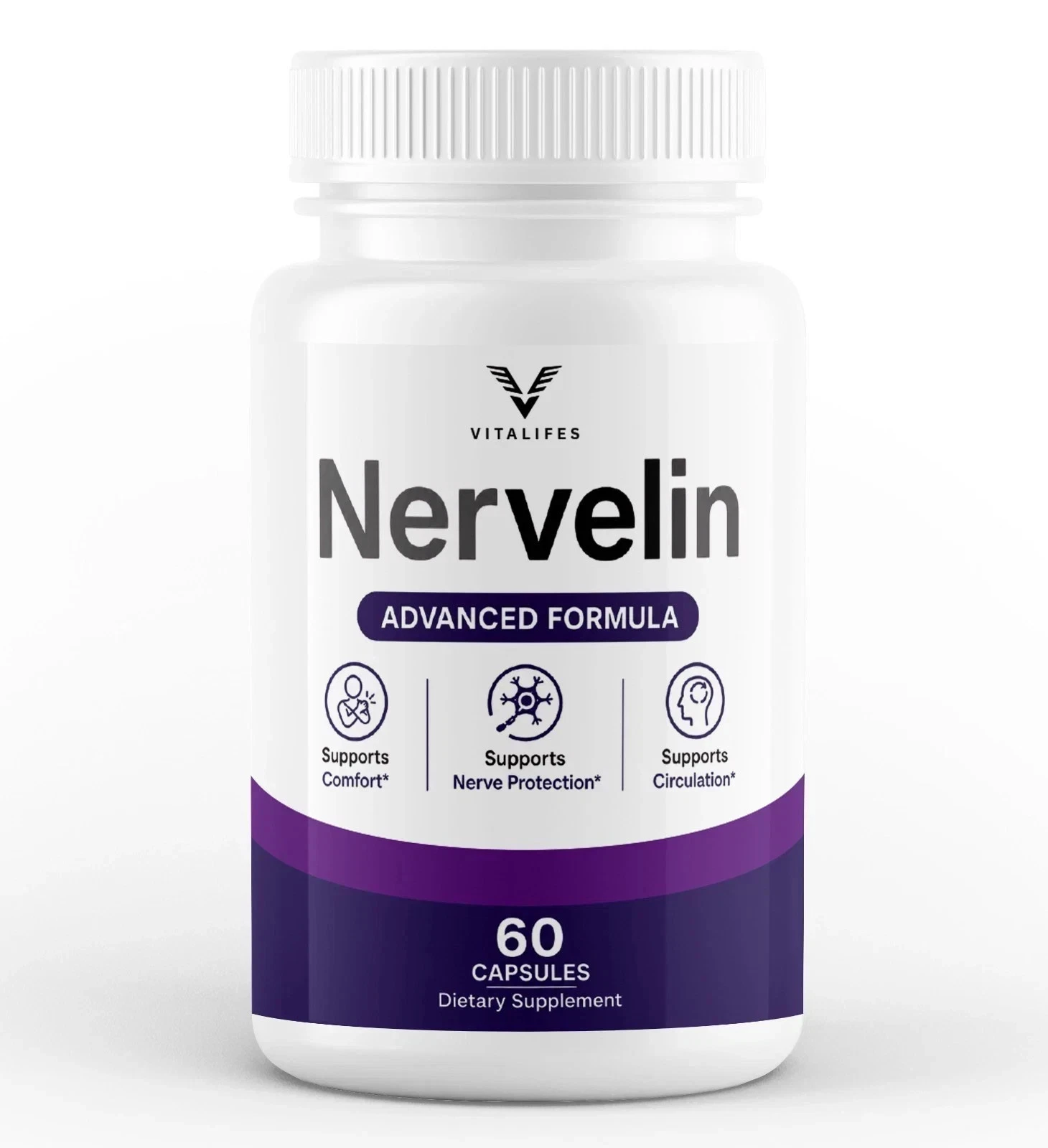
Nervelin: nine names, each beside the dose its own research used
The ingredients page sets every one of the nine against the condition it was actually studied in, so you can see what this label is and is not carrying.
Two capsules a day · 60 capsules a bottle · price at the marketplace checkout
Order Nervelin On The Official WebsiteLot NER-26/GE-1959 · marketplace return window · gelatin capsule
Vitamin B12, which is a different kind of question
B12 belongs in this list for a reason that makes it unlike the other three. It is not a supplement with a trial in neuropathy so much as a deficiency that causes neuropathy, and replacing it is treatment of a cause rather than support of a symptom.
The Diabetes Prevention Program follow-up established the scale of the problem: long-term metformin use is associated with B12 deficiency, and metformin is among the most widely prescribed medicines in the world.
A systematic review of supplementation in metformin users looks at what happens when the deficiency is corrected, which is the practical question for anyone in that position.
The reason this matters to a shopper is blunt: if a medicine has depleted your B12, a botanical blend is not the answer to that problem and a blood test is. This is the clearest example in the whole category of a treatable cause being identifiable rather than guessed at.
It is a question with an answer, and the answer comes from a blood result rather than a shelf. Anyone on long-term metformin with new numbness has a specific, ordinary thing worth checking.
What the guidelines do with all of this
The 2022 American Academy of Neurology guideline update covers oral and topical treatment of painful diabetic polyneuropathy. It is a guideline about medicines, and the honest reading of it is that supplements are not what it recommends.
That is not a contradiction of everything above. A guideline weighs the whole evidence base against the demands of clinical practice, and 'a trial exists' is a lower bar than 'this is what to do first'. Both statements can be true.
What it means practically is an order of operations. Find the cause, address what is addressable, and treat a supplement as something taken alongside that rather than instead of it.
Reading a botanical panel against these four
Now the comparison this article exists to make. Put the four trial rows beside the label this website sells and the result is unambiguous.
| What the trials ran | What a label needs to show it | What this panel shows |
|---|---|---|
| 600 mg of alpha-lipoic acid a day | Alpha-lipoic acid on the panel, with a weight | Alpha-lipoic acid is not on it |
| 300–600 mg of benfotiamine a day | Benfotiamine on the panel, with a weight | Benfotiamine is not on it |
| 1,500–3,000 mg of acetyl-L-carnitine a day | Acetyl-L-carnitine on the panel, with a weight | Acetyl-L-carnitine is not on it |
| B12 replacement where a medicine has depleted it | A B12 row, and a blood result to justify it | B12 is not on it |
Four rows, and the right-hand column is the same in all four. The nine names on this panel are a different set of ingredients with a different research base.
The nine names on this panel — L-lysine, apple cider vinegar, Garcinia cambogia, Tongkat Ali, horny goat weed, wild yam, cinnamon, bitter melon and raspberry ketones — are a different set of ingredients with research in different conditions. The ingredients page sets each one beside what it was actually studied in and the dose that study used.
There is a second obstacle underneath the first. Even if one of the four were on this panel, the 1000mg blend total means no amount could be read for it, so the comparison would still be impossible. Two separate reasons, and either one on its own would be enough.
- Four ingredients, four dose figures, all published and all checkable.
- Three of the four ran for a year or more, which sets a realistic expectation for any product in this category.
- A label carrying none of the four is not carrying this evidence base, whatever else it carries.
- Knowing the four figures makes you a better reader of every bottle on the shelf, including the ones this desk does not sell.
References
- Ziegler D, Ametov A, Barinov A, et al. Oral treatment with alpha-lipoic acid improves symptomatic diabetic polyneuropathy: the SYDNEY 2 trial. Diabetes Care. 2006;29(11):2365-70. PMID 17065669. https://pubmed.ncbi.nlm.nih.gov/17065669/
- Ziegler D, Low PA, Litchy WJ, et al. Efficacy and safety of antioxidant treatment with alpha-lipoic acid over 4 years in diabetic polyneuropathy: the NATHAN 1 trial. Diabetes Care. 2011;34(9):2054-60. PMID 21775755. https://pubmed.ncbi.nlm.nih.gov/21775755/
- Stracke H, Gaus W, Achenbach U, et al. Benfotiamine in diabetic polyneuropathy (BENDIP): results of a randomised, double blind, placebo-controlled clinical study. Exp Clin Endocrinol Diabetes. 2008;116(10):600-5. PMID 18473286. https://pubmed.ncbi.nlm.nih.gov/18473286/
- Sima AA, Calvani M, Mehra M, et al. Acetyl-L-carnitine improves pain, nerve regeneration, and vibratory perception in patients with chronic diabetic neuropathy: an analysis of two randomized placebo-controlled trials. Diabetes Care. 2005;28(1):89-94. PMID 15616239. https://pubmed.ncbi.nlm.nih.gov/15616239/
- Rolim LC, da Silva EM, Flumignan RL, et al. Acetyl-L-carnitine for the treatment of diabetic peripheral neuropathy. Cochrane Database Syst Rev. 2019;6(6):CD011265. PMID 31201734. https://pubmed.ncbi.nlm.nih.gov/31201734/
- Pratama S, Lauren BC, Wisnu W. The efficacy of vitamin B12 supplementation for treating vitamin B12 deficiency and peripheral neuropathy in metformin-treated type 2 diabetes mellitus patients: A systematic review. Diabetes Metab Syndr. 2022;16(10):102634. PMID 36240684. https://pubmed.ncbi.nlm.nih.gov/36240684/
- Aroda VR, Edelstein SL, Goldberg RB, et al. Long-term Metformin Use and Vitamin B12 Deficiency in the Diabetes Prevention Program Outcomes Study. J Clin Endocrinol Metab. 2016;101(4):1754-61. PMID 26900641. https://pubmed.ncbi.nlm.nih.gov/26900641/
- Price R, Smith D, Franklin G, et al. Oral and Topical Treatment of Painful Diabetic Polyneuropathy: Practice Guideline Update Summary: Report of the AAN Guideline Subcommittee. Neurology. 2022;98(1):31-43. PMID 34965987. https://pubmed.ncbi.nlm.nih.gov/34965987/