Nervelin Official Website › Blog › Wild Yam And The Progesterone Claim
Wild Yam And The "Natural Progesterone" Claim: What The Research Shows
Wild yam is the sixth of nine names on this panel, and it is also the plant behind one of the most widely repeated claims in the supplement aisle — that it is a source of "natural progesterone." The claim has a real history and a real chemistry behind it, and the two do not lead where the marketing usually implies. This website's own label makes no progesterone claim for its wild yam; this article explains why that restraint is the correct one.
- Wild yam contains diosgenin, a plant compound that industrial chemistry CAN convert into progesterone — but only in a laboratory, using reagents the human body does not have.
- The human body cannot perform that conversion. Eating or applying wild yam does not raise your progesterone level.
- A controlled 2001 trial in menopausal women found wild yam extract produced no significant change in sex hormone levels, including progesterone.
- Wild yam sits sixth of nine names on this 1,000 mg panel, giving it a ceiling of about 166 mg and no printed floor.
- This label does not claim a progesterone or hormonal effect for its wild yam, which is the accurate position given the evidence.
Where the "natural progesterone" idea came from
The claim traces back to real pharmaceutical history. In the mid-20th century, chemists discovered that diosgenin, a compound found in wild yam (Dioscorea villosa) and related species, could serve as a starting material for synthesizing steroid hormones, including progesterone, in a laboratory. This work was genuinely important — it helped make hormone medications, including early oral contraceptives, commercially viable.
Somewhere between that laboratory history and the modern supplement aisle, the process got dropped from the story. What survived was a simpler, wrong version: that wild yam itself contains progesterone, or that the body can make the same conversion the chemists did. Neither is true.
The chemistry the marketing usually skips
Turning diosgenin into progesterone is a multi-step chemical synthesis. It requires specific reagents and industrial laboratory conditions to break and rebuild molecular bonds in a sequence the compound cannot undergo on its own. The human digestive system has no equivalent process, and neither does human skin.
Diosgenin is a precursor a chemist can turn into progesterone in a lab. It is not a precursor your body can turn into progesterone by eating it or rubbing it on your skin. Those are two different claims, and only the first one is true.
This distinction is why "wild yam cream" products marketed for menopause or hormone balance have drawn scrutiny from researchers for decades: the biochemical mechanism the marketing implies does not exist inside a human body, however real it is inside a chemistry lab.
The industrial history in a bit more detail
The link between wild yam and hormone medicine runs through 20th-century industrial chemistry rather than folk remedy. Diosgenin, extracted from wild yam and related plants, became a practical starting material for large-scale steroid synthesis because it was cheap, plentiful, and chemically close enough to the target molecules to make conversion economical at industrial scale.
That conversion is a defined sequence of laboratory reactions — oxidation, degradation of side chains, and further synthetic steps — carried out with specific chemical reagents under controlled conditions. It was this kind of process, not digestion, that made diosgenin-derived steroids commercially viable in the mid-20th century and helped bring down the cost of hormone medications generally, including early hormonal contraceptives.
None of those reaction steps happen in a human stomach, liver, or skin. The historical fact that diosgenin COULD become progesterone in an industrial setting is the entire basis for the modern claim that wild yam creams and capsules ARE a source of progesterone — and it is also exactly the fact that shows the claim does not hold up outside a laboratory.
The 2001 trial that tested it directly
The clearest way to settle a mechanism claim is to measure it, and that has been done. A 2001 controlled trial published in Climacteric, the journal of the International Menopause Society, gave wild yam extract to healthy menopausal women and measured menopausal symptoms, lipid levels, and sex hormones, progesterone included.
The trial found no significant change in sex hormone levels from the wild yam extract. Symptom scores did not separate meaningfully from what would be expected without a hormonal mechanism at work. This is a direct, measured answer to the specific claim, not an inference from chemistry alone.
That result matters more than the chemistry argument on its own, because a mechanism can look plausible on paper and still fail to produce a measurable effect in real people at a real dose. Here, both lines of evidence — the biochemical explanation for why the conversion cannot happen in the body, and a controlled trial measuring hormone levels directly — point the same direction, which is a stronger position than either one alone would be.
A 2014 review of the wider menopause-herb field
A 2014 review in Maturitas, "Herbal preparations for the menopause: beyond isoflavones and black cohosh," surveyed the evidence for several herbal options used for menopausal symptoms, wild yam among them. Its treatment of wild yam was consistent with the 2001 trial: no established hormonal mechanism, and no strong evidence of clinical benefit for menopausal symptoms specifically attributable to it.
Reading the trial and the review together gives a rare thing in this category — a direct experiment and a broader survey of the field pointing the same direction, rather than one study standing alone against silence.
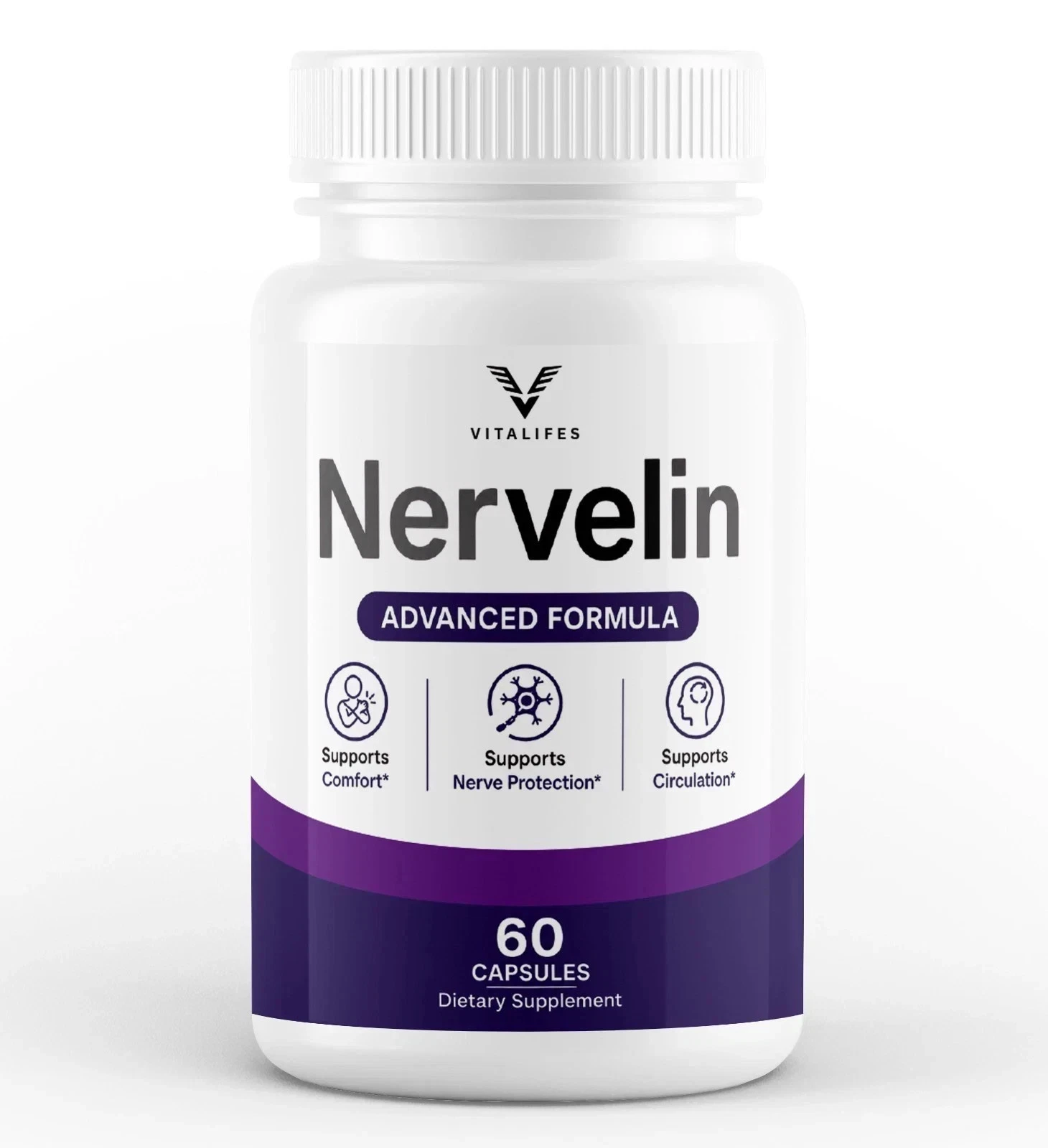
Nervelin: nine names, each beside the dose its own research used
The ingredients page sets every one of the nine against the condition it was actually studied in, so you can see what this label is and is not carrying.
Two capsules a day · 60 capsules a bottle · price at the marketplace checkout
Order Nervelin On The Official WebsiteLot NER-26/GE-1959 · marketplace return window · gelatin capsule
What wild yam is actually studied for, separately from the myth
Setting the progesterone claim aside does not mean wild yam has no research interest at all. Diosgenin and related saponin compounds in the Dioscorea genus have been reviewed for other biological activity — laboratory and preclinical work on anti-inflammatory and metabolic effects, among other areas, distinct from any hormonal mechanism. A 2023 review in Molecules surveyed this wider body of research on Dioscorea bioactive compounds and their potential relevance to inflammatory and metabolic conditions.
This is worth separating clearly from the progesterone question: it is legitimate, ongoing research territory, but it is preclinical and laboratory-stage work on isolated compounds, not evidence that a capsule containing wild yam extract at an undisclosed dose produces those effects in a person. The two questions — "does wild yam have biologically active compounds worth studying" and "does wild yam raise progesterone in the body" — have different answers, and conflating them is part of how the marketing myth persists. A reader who sees "studied for inflammation" and "linked to progesterone" side by side on a product page should not assume both claims rest on the same kind or quality of evidence; they plainly do not.
As with any botanical ingredient, anyone pregnant, breastfeeding, managing a hormone-sensitive condition, or taking hormonal medication should raise wild yam with a clinician before use, independent of whether its marketed mechanism holds up — the general caution around botanicals in those situations applies regardless of which specific claim is or is not accurate.
Where wild yam sits in this blend
This panel prints "Test Boost Proprietary Blend 1000mg" above nine names in descending order by weight. Wild Yam Extract is sixth of the nine, which under blend-order labeling rules sets its ceiling at 1,000 mg divided by its position — about 166 mg. As with every name on this panel, no floor is printed; the true amount could be anywhere from a trace up to that ceiling.
| Position | Ingredient | Ceiling per 2 capsules |
|---|---|---|
| 1st | L-Lysine HCL | 1,000 mg |
| 4th | Tongkat Ali Extract | 250 mg |
| 5th | Horny Goat Weed Extract | 200 mg |
| 6th | Wild Yam Extract | About 166 mg |
| 9th | Raspberry Ketones | About 111 mg |
A ceiling is the most an amount could be, calculated from the ingredient's position in the list — never a confirmed figure.
What this label does, and does not, claim
This is the comparison the "natural progesterone" question actually turns on: not how much wild yam is in the capsule, but what the seller says it does. This panel and this website's own pages make no progesterone claim, no hormone-balancing claim, and no menopause claim for wild yam. It is listed as one of nine names inside a blend whose stated positioning is "Test Boost," not as a standalone hormonal ingredient with its own promise attached.
| What the marketing myth claims | What the research shows | What this label claims |
|---|---|---|
| Wild yam raises progesterone in the body | No significant hormone change measured in a controlled trial | No progesterone claim made |
| Wild yam is "natural HRT" | No established clinical mechanism for that effect | No hormone-replacement claim made |
| Diosgenin converts to progesterone in the body | The conversion is a laboratory process, not a digestive one | No conversion claim made |
That restraint is worth noting plainly, because it is not the industry default. Plenty of wild-yam products on the wider market do carry progesterone or hormone-balance language on their own packaging or marketing copy, which is exactly the claim the 2001 trial and the chemistry above do not support. A related piece on this site covers a different kind of mismatch, reading a proprietary blend panel as a document rather than a promise; this is the inverse case, where a widely believed claim about an ingredient is simply absent from the label rather than overstated on it.
- The "natural progesterone" claim about wild yam comes from real 20th-century pharmaceutical chemistry, not from anything the human body can do.
- A direct controlled trial found no significant hormone change from wild yam extract in menopausal women.
- Wild yam sits sixth of nine on this panel, with a calculated ceiling of about 166 mg and no confirmed amount.
- This label itself makes no progesterone or hormone claim for its wild yam — a position the evidence supports.
References
- Komesaroff PA, Black CV, Cable V, Sudhir K. Effects of wild yam extract on menopausal symptoms, lipids and sex hormones in healthy menopausal women. Climacteric. 2001;4(2):144-50. PMID 11428178. https://pubmed.ncbi.nlm.nih.gov/11428178/
- Depypere HT, Comhaire FH. Herbal preparations for the menopause: beyond isoflavones and black cohosh. Maturitas. 2014;77(2):191-4. PMID 24314619. https://pubmed.ncbi.nlm.nih.gov/24314619/
- Wang Z, Zhao S, Tao S, Hou G, Zhao F, Tan S, Meng Q. Dioscorea spp.: Bioactive Compounds and Potential for the Treatment of Inflammatory and Metabolic Diseases. Molecules. 2023;28(6). PMID 36985850. https://pubmed.ncbi.nlm.nih.gov/36985850/