Nervelin Official Website › Blog › Tongkat Ali And The 2022 Meta-Analysis
Tongkat Ali And Testosterone: What The 2022 Meta-Analysis Actually Pooled
One trial is a data point. Five trials pooled into one number, with a stated confidence interval, is a different kind of evidence, and a 2022 systematic review did exactly that for Eurycoma longifolia and testosterone. It is not the same document as the single-trial dose research this panel's Tongkat Ali row is more often summarized by, and reading the two side by side, together with a separate 2021 trial in a completely different population, changes what the row can fairly be said to support.
- A 2022 systematic review screened nine controlled trials of Eurycoma longifolia and testosterone, pooling five of them into a formal meta-analysis.
- The pooled effect was a significant rise in total testosterone (SMD 1.352, 95% CI 0.565–2.138), and the authors framed the finding around men with hypogonadism specifically.
- A separate 2021 randomized trial in healthy young men found a rise in testosterone too, but proposed a different mechanism — stress-axis hormone production rather than a direct gonadal effect.
- Those two documents describe the same rising number arrived at, plausibly, by two different routes in two different populations.
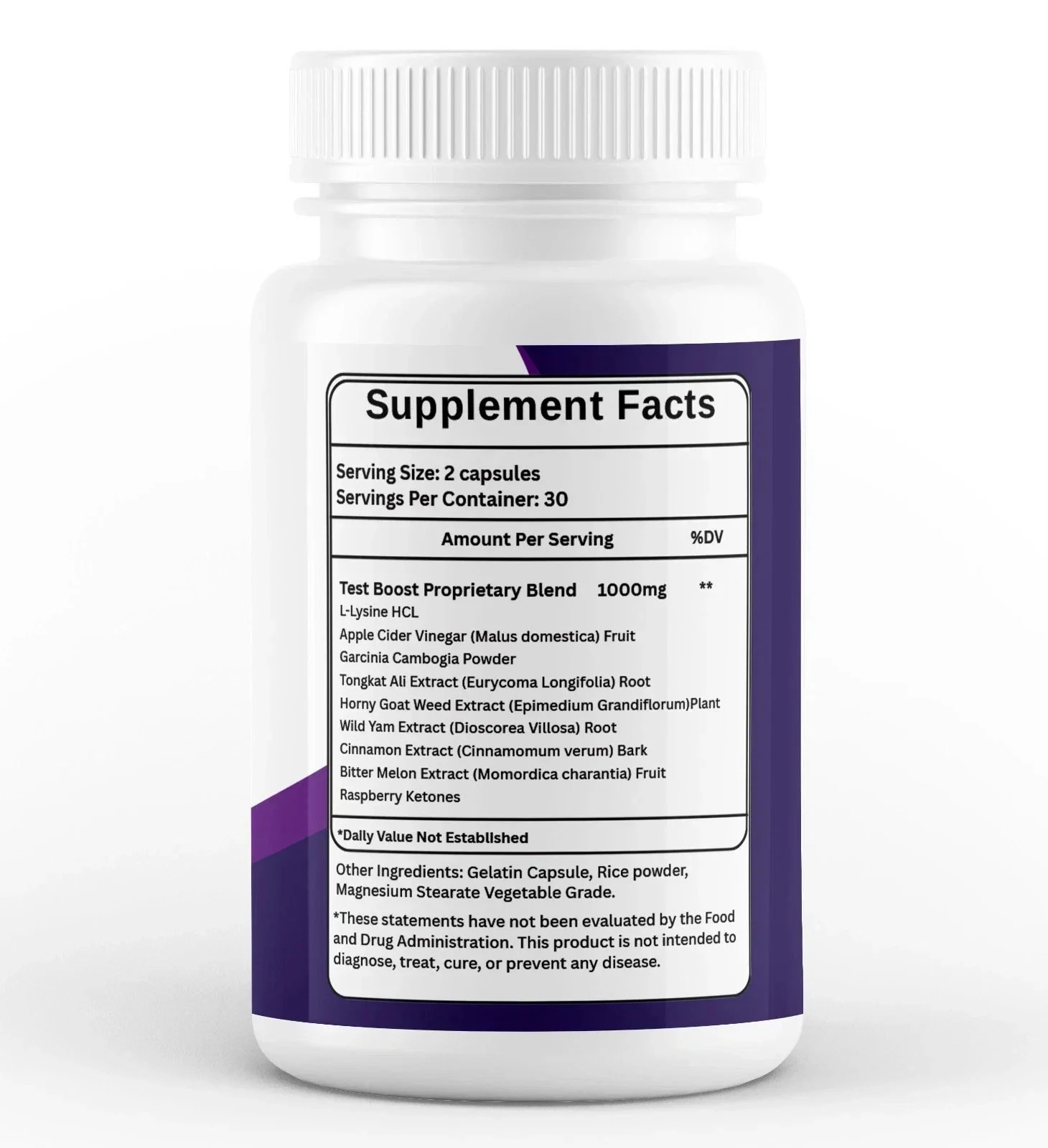
- On this panel, Tongkat Ali is fourth of nine, giving it a ceiling of about 250 mg of the 1,000 mg blend and no printed floor.
What a meta-analysis pools, and why that is different from one trial
Most of the individual ingredient research on a proprietary-blend panel comes down to one or two named trials, and Tongkat Ali is unusual in that its literature is large enough to have been formally pooled. A systematic review does two jobs a single trial cannot: it searches the published record for every study that meets a defined set of criteria, and then, where the studies are similar enough in design, it combines their results statistically into one estimate with its own confidence interval.
That combined estimate is worth more than any one of the individual trials feeding it, for a simple reason. A single trial can turn up a real effect by chance, particularly if it enrolled a small number of people, and a single trial can equally miss a real effect the same way. Pooling several trials narrows that uncertainty, which is the entire purpose of running a meta-analysis rather than reading the best-looking study and stopping there.
Nine screened, five pooled: what happened to the other four
Leisegang and colleagues, publishing in Medicina in 2022, searched the literature for randomized, placebo-controlled trials testing Eurycoma longifolia against testosterone outcomes in men. Their search turned up nine candidate trials. Only five of those nine were similar enough in design and outcome reporting to be entered into the statistical pooling itself.
| Step | What it means | Count |
|---|---|---|
| Trials screened | Randomized, placebo-controlled studies identified by the search as potentially relevant | 9 |
| Trials pooled | Trials with comparable design and reported outcomes, entered into the meta-analysis itself | 5 |
| Trials excluded from pooling | Screened but not statistically combined, for reasons of design or reporting the review sets out | 4 |
A review this size is not hiding a large discarded literature. Four of nine trials being set aside from the formal pool, while still being discussed narratively, is an ordinary outcome for this kind of methodology, not a red flag on its own.
That distinction matters for a reader trying to weigh the headline number. “Nine trials support this” and “five trials were pooled into this number” are not the same claim, and a systematic review earns its extra credibility specifically by being explicit about which trials cleared the bar for pooling and which did not.
The effect size, in plain terms
The pooled result was a standardized mean difference, written SMD, of 1.352, with a 95 percent confidence interval running from 0.565 to 2.138. An SMD is a way of expressing how far apart two group averages are, measured in units of the data's own spread rather than in raw testosterone units, which is what lets trials using different testosterone assays and different reporting units be combined at all.
As a rule of thumb across behavioral and clinical research, an SMD above roughly 0.8 is generally treated as a large effect. An SMD of 1.352 is well past that threshold, and the confidence interval, while wide, does not cross zero, which is why the authors describe the result as significant. A wide interval is itself informative: it says the true effect could plausibly be closer to the low end (0.565, still a moderate-to-large effect) or the high end (2.138, a very large one), and pinning it down more precisely would take more, or larger, trials than currently exist.
The review's own conclusion is worth quoting rather than paraphrasing, because it is more careful than a marketing summary of the same finding would be: the authors describe Eurycoma longifolia as “a safe and promising therapeutic option, particularly in hypogonadal men,” while also noting that more research is needed before it moves into clinical practice. Promising and proven are different words, and the review uses the first one deliberately.
A second document, a different population, a different mechanism
The 2022 review pooled trials conducted mostly in men with diagnosed or suspected hypogonadism — a clinically low testosterone state. A separate, more recent document asks a different question entirely: what happens in healthy young men who are not low in testosterone to begin with?
Chan and colleagues, publishing in Andrologia in 2021, ran a double-blind, placebo-controlled trial in 32 healthy young men, giving one group 600 mg a day of Eurycoma longifolia extract for two weeks and the other a placebo. Total testosterone, free testosterone and estradiol all rose significantly in the treatment group. Luteinizing hormone, follicle-stimulating hormone and sex hormone-binding globulin, the signaling and carrier markers that would move first if the pituitary gland were driving a direct testicular response, did not change meaningfully.
That pattern led the authors to a specific mechanistic proposal, stated in their own words: the testosterone rise “may be due to a greater rate of hormone production via the hypothalamic-pituitary-adrenal axis” — the body's stress-response hormone system — rather than the reproductive hormone axis a low-testosterone therapy would normally be expected to work through. They go on to suggest the effect “could benefit muscle and strength gain in young adults,” a specific, narrower claim than a general testosterone-boosting one.
Two routes to the same rising number
Put the two documents beside each other and an easy mistake becomes visible. It would be simple to read “testosterone went up” in both a hypogonadal-men meta-analysis and a healthy-young-men trial and conclude that Tongkat Ali is one thing, doing one thing, in anyone who takes it. The two research teams themselves do not support that reading.
| 2022 meta-analysis | 2021 young-men trial | |
|---|---|---|
| Population | Men with hypogonadism, pooled across five trials | 32 healthy young men, testosterone not clinically low at baseline |
| Duration and dose across trials | Varies by trial; the review pools across differing regimens | 600 mg a day, 2 weeks |
| LH and FSH | Not the review's focus | No significant change |
| Proposed mechanism | Not specified as a single pathway by the pooled analysis | HPA-axis-linked hormone production, by the authors' own hypothesis |
Same direction of effect, different population, and a mechanism proposed in the second document that does not require the first document's population to be true.
A rise in testosterone driven by correcting a deficiency in men who are low to begin with, and a rise in testosterone in men who were not low, produced over two weeks and tentatively linked to a stress-hormone pathway rather than the reproductive axis, are not obviously the same phenomenon even though both are reported as “testosterone went up.” Neither document claims they are the same thing, and this page does not collapse them into one either.
Nervelin: nine names, each beside the dose its own research used
The ingredients page sets every one of the nine against the condition it was actually studied in, so you can see what this label is and is not carrying.
Two capsules a day · 60 capsules a bottle · price at the marketplace checkout
Order NervelinLot NER-26/GE-1959 · marketplace return window · gelatin capsule
Setting both documents beside this panel
| What the literature discusses | What a label needs to show it | What this panel shows |
|---|---|---|
| A pooled effect across five trials, mostly in hypogonadal men | Confirmation the product is intended for, or studied in, that population | No population is named; the label carries a general adult-use statement only |
| A specific 600 mg daily dose in the young-men trial | A Tongkat Ali weight on the panel, on its own line | No individual weight — ceiling about 250 mg, sharing the row with eight other names |
| A standardised extract used across the pooled trials | A stated extract ratio or marker-compound percentage | “Tongkat Ali Extract” with the plant part named, no ratio or percentage printed |
Fourth of nine still leaves the true amount unpublished, and it leaves it well under the 600 mg the young-men trial used on its own, before any of the eight other rows are accounted for.
Even taking the ceiling figure at face value, 250 mg is well short of 600 mg, and the pooled trials behind the 2022 review used a range of regimens that the review itself does not reduce to one universal number the way the single-trial Tongkat Ali research elsewhere on this site's sibling coverage does. The ingredients page sets out what is and is not printed for every one of the nine names on this panel.
The nerve question, answered honestly
A reader who arrived here from a nerve-comfort carton deserves the direct answer: neither the 2022 meta-analysis nor the 2021 young-men trial measured nerve conduction, sensory thresholds, neuropathic pain scores or any endpoint a neurologist would recognize as a nerve outcome. Both are hormone studies, full stop.
There is a documented, separate line of research connecting testosterone status to nerve health in specific contexts, most notably diabetic peripheral neuropathy, where low testosterone has been observed alongside nerve damage in some populations. That is a real research thread, and it is not the same as evidence that raising testosterone in a healthy person changes nerve symptoms, and it is not what either document reviewed on this page tested. Nobody ran that study on this ingredient, and nothing on this page claims otherwise.
Why an androgen ingredient sits on a nerve-labeled formula
Tongkat Ali's presence on a nerve-positioned label follows a pattern common across this shelf: an ingredient earns a reputation in one well-studied domain, in this case androgen and stress hormones, and then gets folded into formulas built around a different marketed benefit, on the logic that hormone balance, energy and general vitality are loosely adjacent to how someone feels day to day. That is a marketing logic, not a clinical one, and the two research documents reviewed here support the hormone claim on their own terms without extending to the nerve claim the product name implies.
Five questions worth asking of a pooled result
How many trials were screened versus pooled?
A review that is transparent about the difference, as the 2022 paper is, is more trustworthy than a summary that only reports the headline number.
What population were the pooled trials run in?
A hypogonadal-men result does not automatically transfer to someone whose testosterone is already in a normal range.
How wide is the confidence interval?
A wide interval, like 0.565 to 2.138, says the true effect size is uncertain even when the direction is not.
Was the extract standardised, and to what?
A meta-analysis pools studies of a described preparation; an unstandardised capsule is a different, unstudied preparation even carrying the same plant name.
Does the panel name a dose that can be compared to the trial dose?
On this panel it cannot: the row sits inside a shared blend total with no individual weight printed.
- Tongkat Ali is one of the few ingredients on this panel with a formal meta-analysis behind it, not just single trials, and the pooled effect on testosterone in hypogonadal men was large and statistically significant.
- A separate trial in healthy young men found a testosterone rise too, but proposed a different, stress-axis-linked mechanism rather than a direct correction of deficiency.
- Neither document measured a nerve outcome of any kind.
- Fourth of nine by weight gives this row a ceiling of about 250 mg on this specific panel, below the 600 mg dose used in the young-men trial, with no individual amount printed.
References
- Leisegang K, Finelli R, Sikka SC, Panner Selvam MK. Eurycoma longifolia (Jack) Improves Serum Total Testosterone in Men: A Systematic Review and Meta-Analysis of Randomized Placebo-Controlled Trials. Medicina (Kaunas). 2022;58(8):1047. PMID 36013514. https://pubmed.ncbi.nlm.nih.gov/36013514/
- Chan KQ, Stewart C, Chester N, Hamzah SH, Yusof A. The effect of Eurycoma longifolia on the regulation of reproductive hormones in young males. Andrologia. 2021;53(4):e14001. PMID 33559971. https://pubmed.ncbi.nlm.nih.gov/33559971/
- Tambi MI, Imran MK, Henkel RR. Standardised water-soluble extract of Eurycoma longifolia, Tongkat ali, as testosterone booster for managing men with late-onset hypogonadism? Andrologia. 2012;44 Suppl 1:226-230. PMID 21671978. https://pubmed.ncbi.nlm.nih.gov/21671978/